
Plugins & scanning
Formats, scan paths, FX chains, presets, ARA2, and what to do when a plugin will not show up.
Every track has FX chains, the chains hold built-in effects and third-party plugins, and the plugins come from a scan of the standard directories on your machine. This page covers all three, plus presets, bypass, safe mode, and what to do when a plugin refuses to appear or behave. Shortcuts are from the default OpenStudio keyboard profile; Ctrl is Cmd on macOS.
FX chain positions
| Chain | Where it sits | Typical use |
|---|---|---|
| Input FX | Before the track fader | Input conditioning: EQ, compression, gating |
| Track FX | Before the track fader | Standard insert effects |
| Master FX | On the master bus output | Mastering chain |
A monitoring FX chain also exists. To open a chain, click the FX button on a track header or channel strip; the FX Chain panel shows the current chain, and a chain type selector switches between Input FX and Track FX. The master chain opens from the FX button on the Master strip. Chain presets can be saved and loaded for track, input, and master chains.
Built-in effects
Built-in effects carry the OpenStudio prefix. Use the current names when adding effects from scripts. Editors provide effect-specific controls, preset save and load, and bypass; graphical displays vary by effect.
| Effect | What it is |
|---|---|
| OpenStudio EQ | Parametric equalizer with a graphical display |
| OpenStudio Compressor | Dynamic range compressor with a graph |
| OpenStudio Gate | Noise gate with threshold visualization |
| OpenStudio Delay | Tempo-synced delay with a graph |
| OpenStudio Reverb | Algorithmic reverb with visualization |
| OpenStudio Saturator | Harmonic saturation and distortion |
| OpenStudio Chorus | Chorus modulation |
Two larger built-ins have their own pages: the guitar and bass capture host in NAM Rack setup, and the real-time pitch corrector in Pitch editing. A limiter is also built in, and S13FX script effects with sliders and a native editor are supported.
Formats and scan paths
OpenStudio hosts 64-bit plugins for effects and virtual instruments. VST3 is the stable, most mature path. CLAP and LV2 code paths are present and exposed where the format is available, but individual plugin compatibility varies more than it does for VST3.
Open the FX Chain panel or the Plugin Browser and click Scan. The standard directories are scanned and the results are grouped by manufacturer and category, filterable by name.
~/Library/Audio/Plug-Ins/VST3C:\Program Files\Common Files\VST3/usr/lib/lv2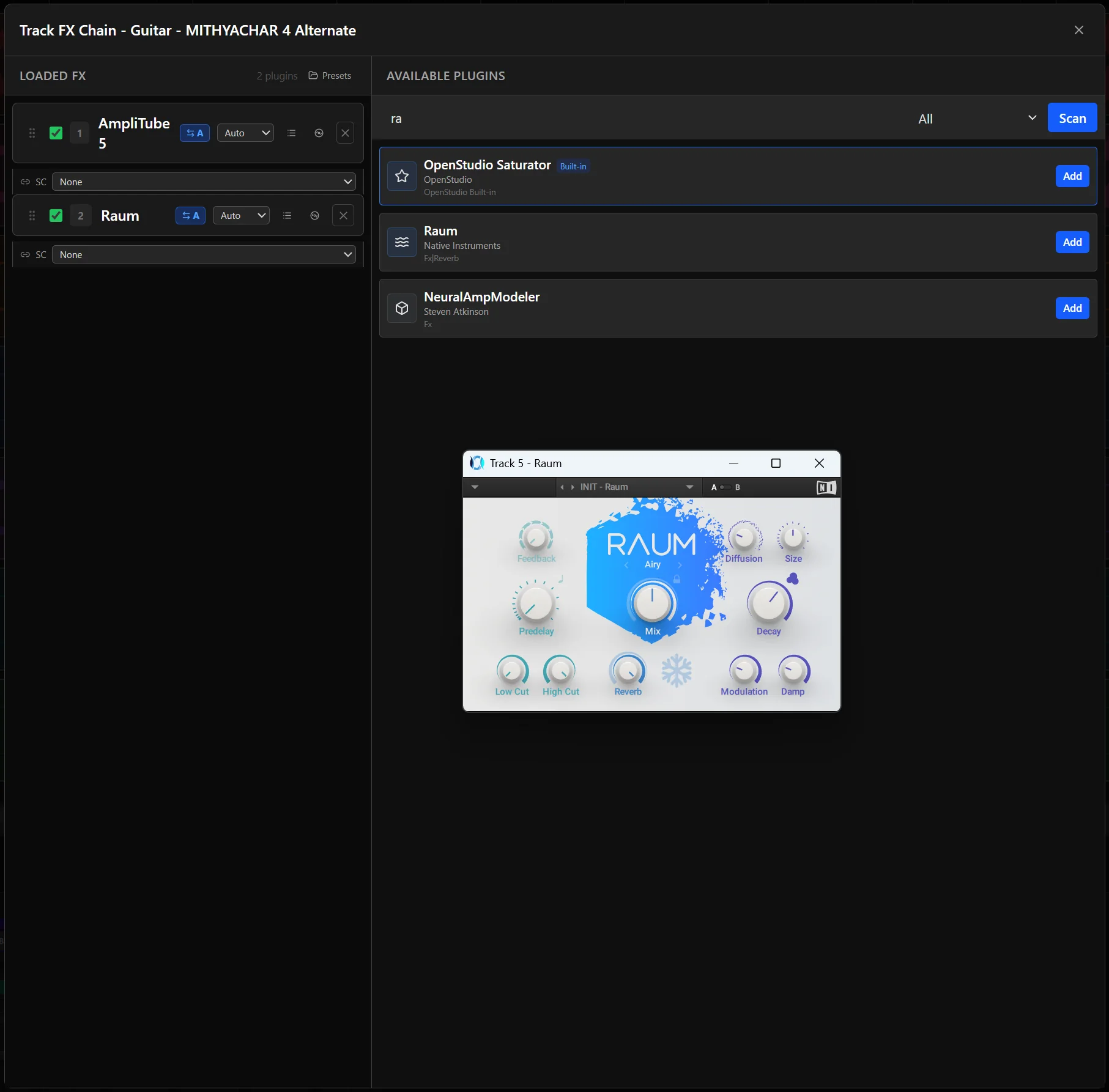
Adding a plugin, editors, presets, and A/B
- Open the FX Chain panel for the track.
- Click + or Add Plugin.
- Filter the list by name, manufacturer, or category and click the plugin.
- It is appended to the chain and its native editor window opens.
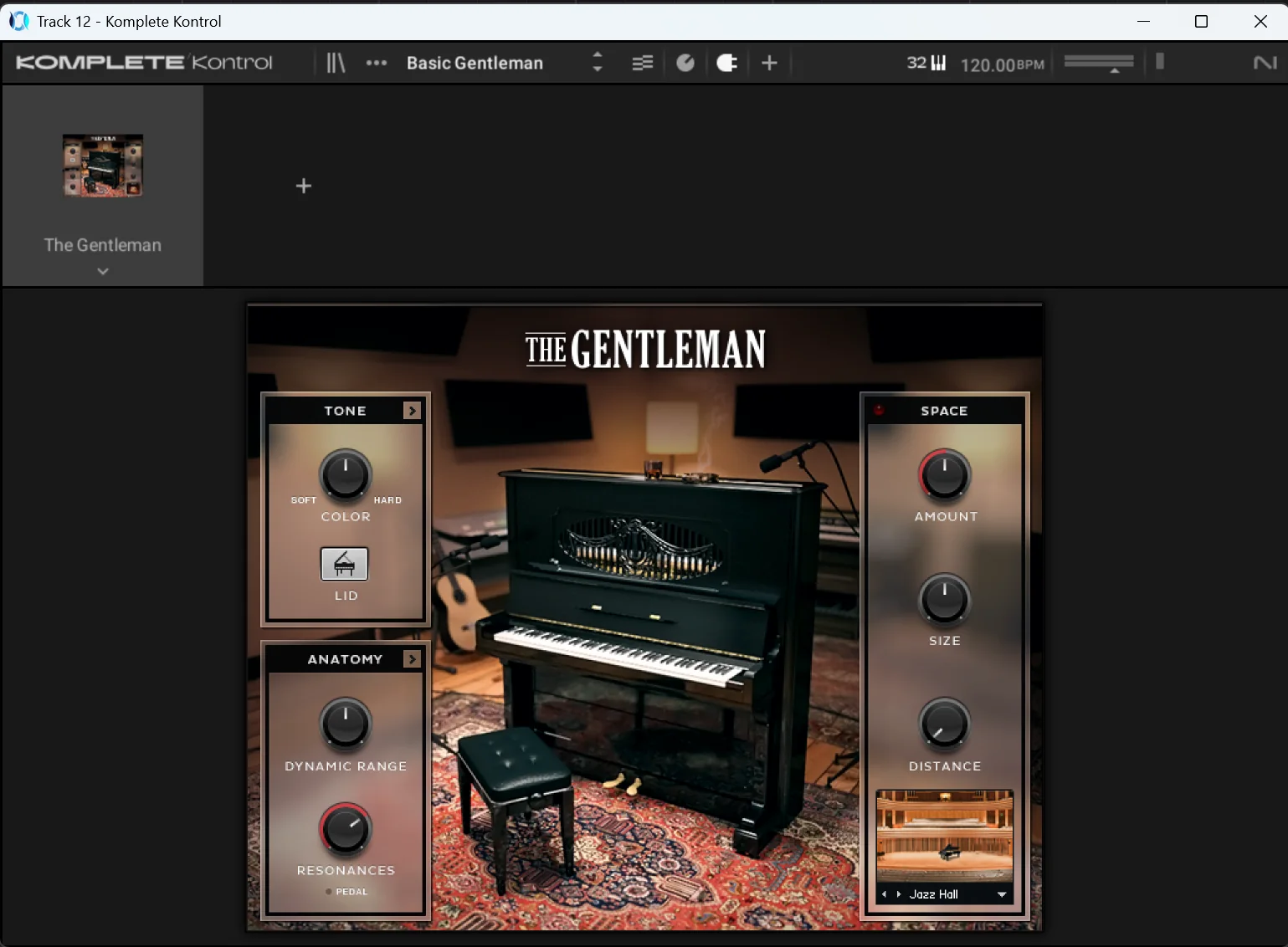
Native editors open in separate windows when the plugin provides one. Parameters can be changed there or from the parameter list in the FX Chain panel, where exposed. Automation uses eligible host-exposed parameters; the track and input FX parameter lists provide MIDI Learn buttons for controller CCs.
To save a preset, set the parameters, click the preset save icon in the FX Chain panel, and name it. Load one from the plugin's preset browser. Plugin state is also stored in the project. For VST3 plugins, A/B comparison gives you two independent slots: set up A, switch to B, adjust, and toggle between them to compare by ear.
Bypass, reordering, and safe mode
- FX Bypass on the track header bypasses the whole chain without removing anything. The FX button turns from green (active) to red (bypassed). Individual plugins bypass from inside the FX Chain panel.
- Drag effects within a track or input chain to reorder them; signal flows top to bottom.
- File → Open Project (Safe Mode)… (
Ctrl+Shift+O) skips loading saved instruments and FX. Use a copy for diagnosis and avoid overwriting the original project from this mode.
Reordering by drag is supported for track and input chains. Master FX reordering is not supported in the current UI.
32-bit bridge, ARA2, and sidechain
Sidechain routing into plugins is supported for plugins that take a sidechain input. For an ARA-capable plugin in a track FX chain, the app attempts to initialize ARA, attach the track’s audio clips, and open its editor. This depends on an ARA-enabled build and a compatible plugin; compatibility is not guaranteed for every ARA editor.
A bridge action exists internally, but there is no supported 32-bit hosting workflow. Install the 64-bit version of the plugin.
When a plugin will not show up or misbehaves
Plugin not in the list
- Confirm it is installed in one of the standard directories above.
- Open the FX Chain panel and click Scan again.
- Confirm it is a 64-bit plugin. VST3 is the reliable format; CLAP and LV2 depend on the plugin and the build.
- Check the plugin file is not corrupted, for example by reinstalling it.
Plugin crashes, hangs, or makes noise
- Open a copy in Safe Mode (
Ctrl+Shift+O) to skip loading saved instruments and FX. - Add plugins one at a time in the copy until the problem returns.
- Check the plugin's documentation for channel configuration requirements; some expect a specific layout.
- Update the plugin to its latest version.
- Remove the plugin from the chain and add it again to reset its state.
More symptoms, including audio dropouts caused by heavy plugins, are indexed in Troubleshooting.